








How to Open a JDG (Sole Proprietorship) as a Foreigner in Poland: Current Grounds (Karta Polaka, UKR Status, Business Residence Permit)
10.07.2026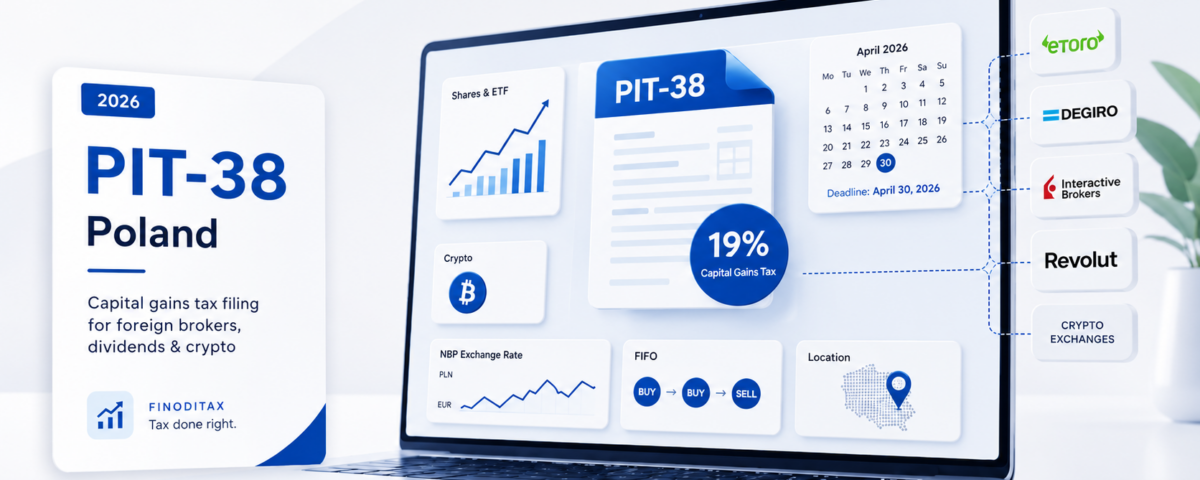
Taxes on Investments and Crypto in Poland- PIT-38 Filing Guide Finoditax
Investing through international platforms has become widely accessible, but generating income in financial markets imposes specific duties on Polish tax residents. All operations involving securities, digital assets, and foreign dividends must be reported annually. In this article, we break down how this process works and how to avoid common mistakes.
Understanding Capital Gains Tax in Poland and Whom It Applies To
Any income earned by an individual from financial market operations is subject to taxation if that individual is recognized as a Polish tax resident. This levy is commonly referred to as the Belka tax. A key feature of this tax is that it is calculated separately from standard employment income and is not combined with it in a single tax return.
- Taxable Objects — This includes income from selling shares, bonds, derivatives, as well as exchanging cryptocurrency for fiat money.
- No Tax-Free Threshold — Unlike some other forms of taxation, capital gains tax is paid on every single zloty of net profit, starting from the very first transaction.
The PIT-38 Form and the Specifics of Global Brokerage Platforms
A specialized form, PIT-38, is used for reporting annual investment income. While Polish brokers provide a pre-filled PIT-8C form that syncs automatically with the tax office, using international platforms requires a different approach.
- Manual Calculations — Platforms like Revolut or Interactive Brokers do not report to the Polish tax office. Investors must manually convert every transaction into PLN using the official National Bank of Poland exchange rates.
- Deductible Costs — You can reduce your taxable base by deducting documented expenses related to acquiring the assets and transaction fees charged by the broker.
Cryptocurrency Taxation for Foreign Residents in Poland
Polish tax regulations clearly define rules for digital asset transactions. Cryptocurrency tax in Poland is triggered only under specific circumstances, allowing investors to manage their portfolios efficiently within the market.
- Taxable Events — Tax liability arises only when you cash out cryptocurrency into fiat currency (USD, EUR, PLN) or use it to pay for goods and services. Crypto-to-crypto exchanges are tax-neutral.
- Declaring Expenses — Even if you did not make a profit in the tax year but bought crypto, these expenses should be declared in PIT-38 to offset future gains.
Reporting Foreign Shares and Dividend Income
Profits from selling foreign securities and receiving dividend payouts are two separate tax categories, though they are declared within the same annual return. Accounting for double tax treaties is crucial here.
- Income from Share Sales — Calculated as the difference between the sale price and the purchase price, converted into PLN using the NBP rate from the business day preceding the transaction.
- Foreign Dividend Taxes — If withholding tax was deducted abroad (e.g., in the US) at a rate lower than the Polish rate, the investor must pay the difference in their local annual return.
Filing Procedures and Avoiding Penalties for Missing PIT-38
Modern electronic tools simplify the tax submission process significantly. Taxpayers can use state digital platforms, but automatically generated drafts still require thorough manual verification.
- Verifying Twój e-PIT — The government portal creates a draft PIT-38, but details regarding transactions via international apps like Revolut or IBKR must be added manually by the taxpayer.
- Consequences of Non-Compliance — Substantial penalties apply for failing to submit PIT-38 in Poland on time or for presenting incorrect numbers. If you spot a mistake after filing, you must submit a correction (korekta) immediately.
Need accounting support?
Need help calculating profits from Revolut, Interactive Brokers, or crypto exchanges? Contact Finoditax experts to accurately file your PIT-38 declaration.

